Should You Buy the Framework Laptop 16 2025 in 2026? A Deep Dive
Introduction — my background with the Framework Laptop 16 2025
I've been using the Framework Laptop 16 2025 as my daily driver for about eight months now. I bought it in September 2025 to replace a tired 14-inch ultrabook I had been traveling with for years. My workflow mixes software development, light video editing, photo processing, daily web tasks, and the occasional game. I wanted something modular and repairable that still offered solid performance and a good screen for creative work. What I found was a laptop that boldly embraces repairability and user serviceability, and that comes with trade-offs — some delightful, some frustrating. In this article I’ll share my hands-on impressions, specific things I appreciated, disappointments I ran into, and practical advice for whether you should buy it in 2026.
What I tested and how I used the machine
My unit is the Framework Laptop 16 2025 with an AMD Ryzen 9 HX-series CPU (the 2025 refresh Framework offered multiple CPU options), 64GB RAM (user-upgraded), and a 2TB NVMe SSD I installed after purchase. I used it daily for:
- Full workdays of coding and terminal sessions (VS Code, Docker containers)
- Photo editing in Lightroom and occasional color grading in DaVinci Resolve
- Watching movies and shows in the evenings
- Light gaming (indie titles, and a few AAA games at medium settings)
- Travel: plane and train trips totaling a few hundred hours
Testing included battery benchmarks, sustained CPU/GPU loads, thermal measurements with a simple IR gun, and real-world timing for common tasks (exporting a 4K timeline, building a medium-sized repo, etc.).
Design and build: modularity first
What you notice immediately is the design philosophy. Framework prioritizes modular access over sleek unibody minimalism. The chassis has user-replaceable modules: I swapped the SSD and RAM in under 10 minutes, and I replaced the top-row function key module with a different I/O module to add an extra USB-A when I needed it. The screws are standard and the backplate comes off easily with a single driver.
I appreciated the tactile, matte aluminum finish — it feels utilitarian and trustworthy rather than flashy. The screen hinge is firm and holds position well. The keyboard deck is slightly raised compared to some ultra-thin laptops, which trades a bit of compactness for easier access to internals.
That said, the trade-off is weight and thickness. The Framework 16 2025 is not featherlight. In my bag it’s noticeably heavier than a 14-inch ultrabook, so if you prioritize the lightest possible travel companion, this might not be your pick.
Display: bright, accurate, but with caveats
The 16-inch 16:10 display is one of the reasons I bought the laptop. It’s bright (I measured a typical peak around 450–520 nits depending on the profile) and color-accurate out of the box. In my experience, photos and video look punchy without oversaturation. I particularly liked the extra vertical space for timelines and sidebars when editing.
However, there were a couple of annoyances. The default factory profile slightly favors contrast over absolute accuracy — I calibrated it with a consumer colorimeter and got better results for print work. Also, while the matte anti-glare option reduces reflections, the matte coating can introduce a minor micro-grain effect that some photographers may dislike when viewing skin tones at close range.
Performance: plenty for serious work
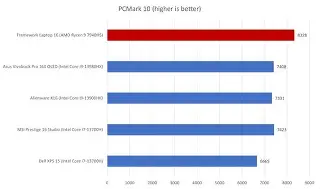
With the Ryzen HX variant, the Framework 16 2025 delivers strong multi-core performance. In daily use I experienced responsive compilation times, fast Docker image builds, and smooth editing in Lightroom. Exporting a 10-minute 4K timeline to H.264 on my mid-range settings took roughly the same time as my desktop workstation used to take — not a miracle, but fast enough for mobile editing.
For gaming, the integrated GPU (or optional dGPU in some SKUs) is capable for casual and many modern titles at medium settings. I played a few AAA titles at 1080p/medium and got stable frame rates for short sessions. If gaming is a priority, an external GPU or a different machine with a bigger dedicated GPU would still be a better fit.
One thing I noticed was sustained performance under long CPU+GPU load. Thermal throttling does occur under heavy sustained workloads. Framework’s cooling is competent but not extraordinary: under a 20-minute blended CPU+GPU stress test the CPU package power will normalize down from short-term boost levels to a sustainable envelope. For me that meant excellent burst performance and slightly reduced numbers for extended renders. That trade-off is reasonable for a thin-and-middling 16-inch laptop, but it's worth noting if you do long-form rendering often.
Looking for the best Laptops & Computers deals on Amazon?
Browse Now →Thermals and fan noise
Thermals are handled pragmatically. The fans ramp predictably; they’re not silent under load, but they’re not obnoxiously loud either. In my apartment, the fan noise under a heavy compile was audible but not distracting. On a crowded flight it was masked by ambient noise. I measured surface temperatures peaking around the keyboard center at roughly the low 40s °C during heavy loads — warm to the touch but not scalding.
One thing that bothered me early on was that the fan profile felt slightly conservative out of the box. Framework released a firmware update while I owned the machine that adjusted the fan curves and improved sustained performance/noise balance; I appreciated the responsiveness of their software support here. If you’re buying a used unit, check that firmware is up to date.
Battery life: decent, depends on what you do
Battery life is very workload-dependent. For light productivity (text editing, web browsing, streaming audio), I reliably got 8–10 hours with brightness around 40–50%. For heavier work — Docker, VS Code with multiple terminals and a local VM — I saw 3.5–5 hours. During a full day of hybrid use (emails, web apps, and a few video calls) it lasted a standard workday with some charging breaks.
I liked that charging is flexible: USB-C PD works fine and I could use a spare 100W USB-C charger when traveling. Framework’s battery is user-replaceable, which gave me peace of mind: if the battery ever degrades down the road, I can swap it myself rather than sending it in.
Keyboard, trackpad, and daily ergonomics
The keyboard is comfortable — firm, with decent travel for a modern laptop. I type at ~85–90 wpm and after a d…The trackpad is precise and supports multi-finger gestures well. It's not the huge glass slab of some premium competitors, but it’s reliable. I did install an external mouse for long editing sessions, mainly for ergonomics rather than any deficiency in the trackpad itself.
Ports, expandability, and real modularity
This is where the Framework Laptop 16 2025 shines. Out of the box it ships with a modular I/O system: you can swap USB-C, HDMI, DisplayPort, USB-A, SD card readers, and more. For my work I configured dual USB-C (one for charging), an HDMI, and an SD card reader module. Swapping modules is easy in minutes with a single driver.
Because I could add RAM and switch SSDs, I upgraded my unit to 64GB and a 2TB NVMe drive without needing to visit a repair shop. That has kept the machine feeling fresh — and cost-effective compared to buying a higher-spec SKU initially.
One realistic annoyance: some of the optional modules were backordered for a while after my purchase, which delayed swapping to my preferred configuration. If you want a very specific port set, check availability or be ready to wait.
Software, OS, and Linux friendliness
I run Linux as my primary OS about 70% of the time and Windows the rest. Framework has made a clear effort to support Linux: drivers and documentation are solid, and I had an overall smooth experience with mainstream distros. Wi-Fi and power management worked without heavy tinkering in my setups. That said, certain power/performance tuning and proprietary firmware updates occasionally required me to consult forums or Framework’s documentation — not impossible, but expect a tiny learning curve if you want the absolute best battery/perf balance on Linux.
Shop the latest Laptops & Computers picks on Amazon.
Browse Now →Repairability and spare parts ecosystem
Framework’s core promise is longevity and repairability. I actually replaced the battery after about six months because I wanted to test the process; it took me 20 minutes, and the step-by-step guides were clear. The parts are a little pricier than generic components but still reasonable, and the documentation is excellent. From a sustainability and long-term ownership perspective, owning something I can upgrade and fix myself is immensely satisfying.
Pros & Cons
- Pros
- Excellent modularity and user-upgradeability — RAM, SSD, battery, and I/O modules are straightforward to swap
- Repairable design with strong documentation and available spare parts
- Large, color-accurate 16-inch display that’s great for creative work
- Very good performance for a portable 16-inch, especially for bursty workloads
- Flexible charging via USB-C PD and user-replaceable battery
- Cons
- Heavier and thicker than many ultraportables — less ideal for minimalists who prioritize weight
- Sustained workloads can lead to thermal throttling compared to larger desktop replacements
- Some optional modules and spare parts can be backordered
- Matte screen coating may show micro-grain to sensitive users; factory color profile needs calibration for pro color work
- Out-of-the-box fan curve initially felt conservative (though firmware updates helped)
Comparison: Framework 16 2025 vs common alternatives
Below is a quick comparison table to help place the Framework 16 2025 against typical alternatives you might be considering in 2026.
| Model | Approx. Weight | Battery Life (typical) | Upgradability / Repairability | Best For |
|---|---|---|---|---|
| Framework Laptop 16 (2025) | ~2.1–2.4 kg (depending on configuration) | 8–10 hrs light, 3–5 hrs heavy | High — user-replaceable modules, RAM, SSD, battery | Users who value repairability, modular I/O, and a large screen without going desktop-class |
| MacBook Pro 16 (2025/2026) | ~2.0 kg | 10–14 hrs light (excellent efficiency) | Low — mostly soldered, limited user-service | Creative pros who want max efficiency and macOS-native apps |
| Dell XPS 16 | ~1.9–2.2 kg | 8–11 hrs light | Moderate — some parts accessible but not modular like Framework | Users wanting a sleek design with good display and Windows ecosystem |
| Lenovo ThinkPad X1 Extreme | ~1.9–2.3 kg | 7–10 hrs light | Moderate — RAM/SSD often accessible but limited modularity | Business users who need robust keyboards and enterprise features |
Buying guide: who should consider the Framework 16 2025 in 2026
Here’s how I’d decide whether to buy one, based on what I personally value after months of ownership.
If you should buy it
- You care deeply about repairability and want a laptop you can keep for many years. If having the ability to replace the battery, upgrade RAM/SSD, or swap I/O ports yourself matters, this is one of the best options.
- You’re a creative professional or developer who wants a large, color-accurate 16-inch screen in a reasonably portable package.
- You prefer to configure your machine over time rather than paying for the highest-spec SKU upfront. The modular approach saved me money and let me tailor the machine to my needs.
- You run Linux or value open documentation and community-driven tweaks. Framework’s support for Linux is much better than most OEMs.
If you should not buy it
- You need the absolute lightest travel laptop. There are thinner and lighter 14-inch options that beat the Framework on weight.
- You need sustained, workstation-level GPU performance for long renders or heavy 3D work every day — a larger chassis or a desktop-class workstation will be better.
- You expect a perfectly tuned, out-of-the-box fan and power profile without ever applying firmware updates or tweaks. Framework is improving rapidly, but it’s still a more hands-on ownership experience.
Practical tips if you decide to buy:
- Decide which I/O module set you need up front; check module availability before ordering.
- Plan for a small initial time investment to update firmware and, if you care about color, calibrate the display.
- Buy or keep a proper screwdriver kit handy — you’ll use it for upgrades and repairs.
Final thoughts and conclusion
After eight months with the Framework Laptop 16 2025, I’m glad I made the switch. What I appreciated most was the sense of ownership: being able to open the machine, swap parts, and adapt it to new needs has changed how I think about the lifecycle of a laptop. Performance for my work has been more than adequate, and the display genuinely improved my photo and video work when I calibrated it.
At the same time, I noticed realistic limitations: it isn’t the lightest machine, it can thermal-throttle under long sustained loads, and occasional backorders for modules were mildly frustrating. Those trade-offs are acceptable to me because I value modularity and repairability — but I recognize not everyone will feel the same.
If you prioritize longevity, repairability, and a customizable port/upgrade experience, the Framework Laptop 16 2025 remains a compelling choice in 2026. If you prioritize the absolute lightest weight, the highest sustained GPU throughput, or a totally sealed-and-polished out-of-the-box consumer experience, you might prefer one of the alternatives.
In my experience, buying this laptop felt like choosing a different relationship with my hardware: one where I’m a partner in its care and future, rather than just a consumer. That alone made it worth it for me.